The Weight Nobody Names: Mental Health in Rural Nigerian Communities
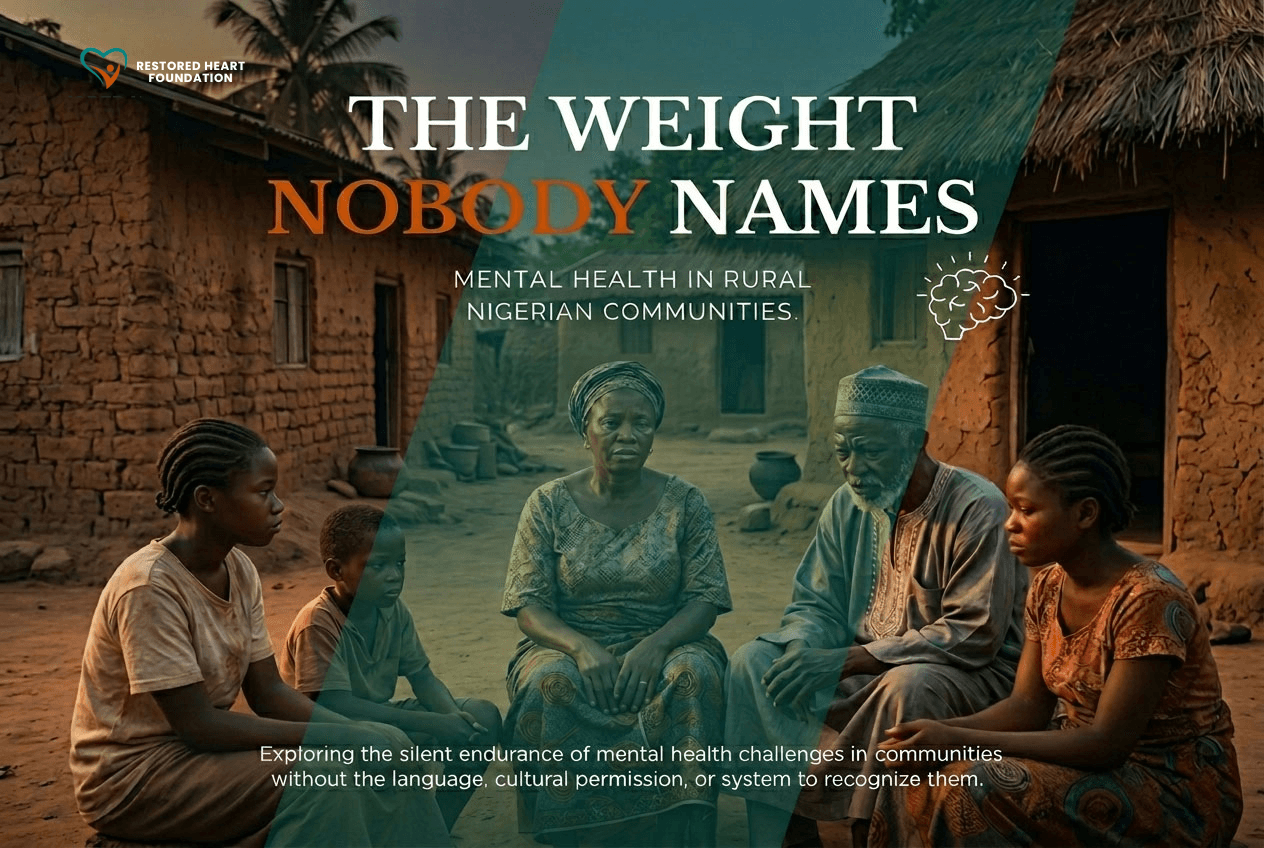
There is a man in a rural community in Nigeria who has not laughed in eight months. His neighbours have noticed, just like his family, but nobody has said anything, not because they do not care, but because no framework in his community would allow anyone to say something is wrong with how a person feels, and that something deserves a response.
So, he gets up every morning to go about his day carrying the weight of something that has no name in his world, and the community around him carries on, too, because this is what communities do when the tools for a different response have never arrived. This is not one man's story; it is the story of many rural Nigerian communities across the country, where mental health conditions are lived with daily, silently, and almost entirely without support.
“There is no framework that would allow anyone to say: something is wrong with how they are feeling, and that something deserves a response.”
The Weight Has Always Been There
Mental health conditions did not arrive in rural Nigerian communities recently. Depression, anxiety, grief, trauma, psychosis, and substance use have always been present. What has been absent is the language to name them, the services to respond to them, and the cultural permission to take them seriously.
In many rural communities, what a health system would identify as depression is described as laziness, spiritual weakness, or a personal failing. What looks like anxiety is dismissed as overthinking or a lack of faith, while trauma is expected to be managed quietly, within the family, without outside help, because seeking outside help would mean admitting that something is wrong, and admitting that something is wrong carries its own cost in communities where reputation and social standing are closely tied to the appearance of resilience.
This is not a criticism of these communities; it is a description of what happens when mental health has never been prioritised in the systems that serve them. When no one has ever visited a community specifically to address it, when no school curriculum has ever given young people the language to describe their inner lives, or when any development program has ever treated mental health as something worth investing in, alongside physical health, education, or economic opportunity. The weight has always been there; it has just never had a name.
Who Is Carrying It
One of the most damaging myths about mental health in underserved communities is that it primarily affects one group. It is the young man who came back from the city with plans that did not work out, who sits in his family compound now feeling like a failure he cannot explain to anyone around him, the elder who watched his community change faster than he could adapt to and who has withdrawn from the social life that used to sustain him, the child who witnessed something they were too young to witness and who carries it silently into every classroom and every interaction, the family that lost someone suddenly and was given three days to grieve before the expectation of returning to normal routine.
Mental health does not discriminate by age, by gender, or by the work someone does, it lives in every demographic in a rural community; in the farmer, the trader, the student, the parent, the community leader, the health worker, in the people who appear to be managing and in the people who have stopped managing, and it lives, most dangerously, in the people who have learned to perform normalcy so well that nobody around them suspects anything is wrong. The weight is everywhere, and almost nobody is naming it.
“It lives in the people who appear to be managing and in the people who have stopped managing.”
What Happens When It Goes Unnamed
The consequences of unnamed mental health conditions in rural communities are not abstract; they are practical, generational, and compounding.
A community member living with untreated depression is less able to contribute to the social and economic fabric of their community, less able to work consistently, to parent attentively, to participate in the collective decision-making that sustains community life. Multiplied across dozens or hundreds of people in a single community, that reduction in functioning becomes a structural drag on everything the community is trying to build.
Children who grow up in households where mental health conditions are untreated and unaddressed absorb patterns of withdrawal, of anger, of shutdown, that they carry into their own adult lives and eventually into their own households. Trauma passes through generations not because it is inevitable but because the tools to interrupt it have never been provided.
Relationships fracture quietly, community cohesion erodes gradually, young people leave not just because of economic opportunity elsewhere but because staying in a community that offers no support for the heaviness they are carrying feels impossible, and the communities left behind become progressively less able to retain the energy and talent they need to sustain themselves.
These are the real costs of unnamed mental health, not dramatic, not visible, but real, cumulative, and entirely preventable.
“Trauma passes through generations not because it is inevitable but because the tools to interrupt it have never been provided.”
What Naming It Changes
The first thing that changes when a community gets a language for mental health is not the availability of services, it is the possibility of conversations.
When a community has words for what its members are experiencing, when depression is something that can be named rather than just felt, when anxiety is something that can be described rather than just endured the isolation that mental health conditions create begins to loosen. People start to recognise themselves in descriptions they have never encountered before, they start to ask questions they have never felt permitted to ask, and they start to reach for help they did not know they were allowed to seek.
This is why the community mental health first aider model that RHF's Mental Health and First Aiders Fellowship program is built around is not just a service delivery mechanism, it is a cultural intervention by training members of the community itself to recognise and respond to mental health needs of people who share the language, the relationships, and the lived experience of those they serve. MHFF is doing something that an external service could never replicate: it is introducing the conversation from within.
A community mental health first aider does not cure depression or resolve trauma. They do something more foundational: they make it possible for a man who has not laughed in eight months to have a conversation about it with someone who will not judge him for it; rather, they make it possible for a community to begin treating the weight it has always been carrying as something that deserves a name, and a response.
“When a community has words for what its members are experiencing, the isolation that mental health conditions create begins to loosen.”
What We Are Asking
Mental health in rural Nigerian communities will not find its way onto the agenda through silence; it finds its way there through organisations like RHF choosing to name it plainly, to write about it honestly, and to make the case that the people carrying unnamed weight deserve the same investment as the people whose needs are easier to photograph and measure.
MHFF is RHF's response; it is not the complete answer, the complete answer requires policy change, sustained funding, and a development sector willing to treat mental health as the foundational issue that it is, but it is the response we can build right now, in the communities we serve, with the resources and relationships we have.
If this post moved you, share it with someone in your network who works in health, with someone who makes funding decisions, with someone who has been carrying their own unnamed weight and needed to read that it has a name.
And if you are an organisation or funder who wants to invest in community mental health in underserved Nigerian communities, we would like to talk to you.
Comments
Loading comments...