The Last Mile Is Not a Distance: It Is a Decision
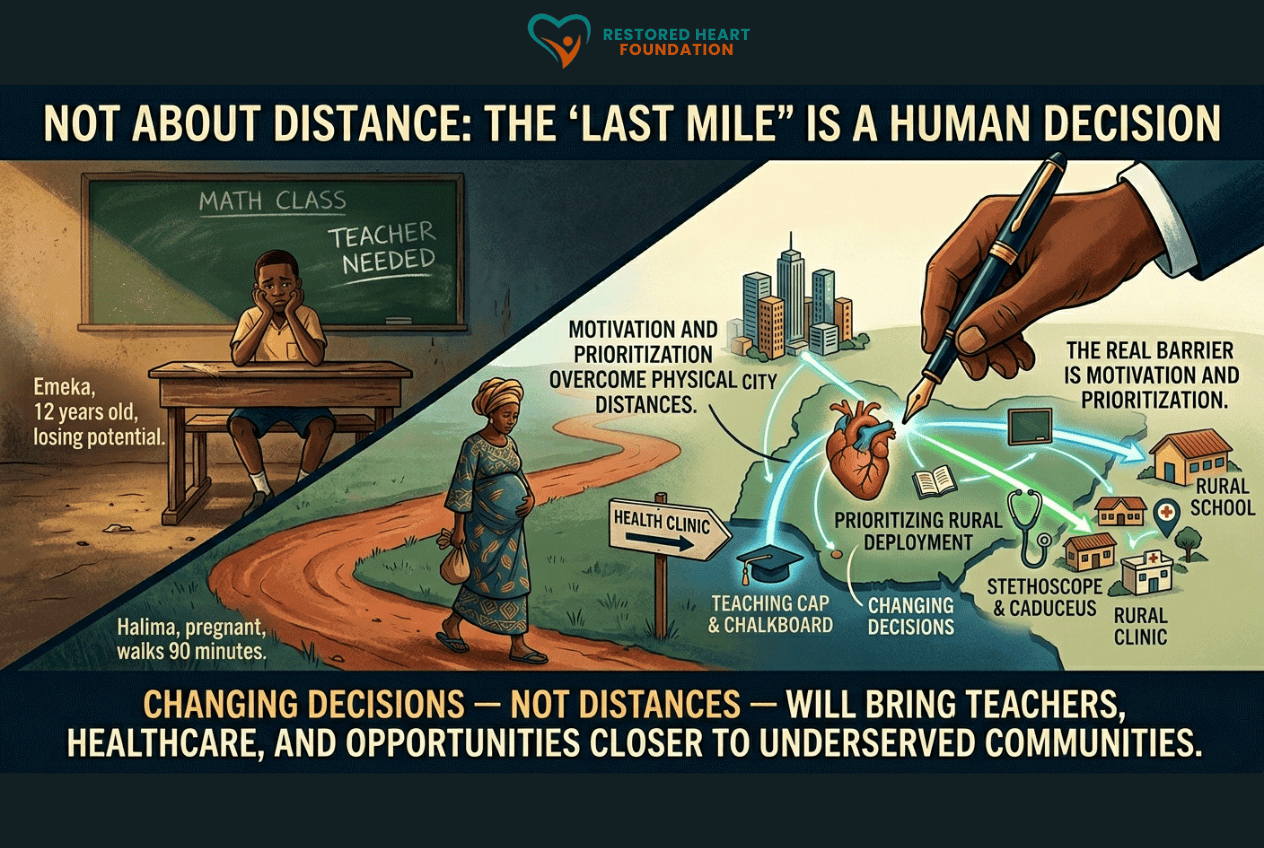
Most of the decisions about where to build, where to post, and where to fund are made by people who have never spent a night in the communities they are deciding about.
Nigeria has engineers who can build roads, doctors who can staff clinics, and thousands of qualified, capable teachers who are currently working in cities because nobody made it worth their while to go anywhere else. The communities that stay underserved stay underserved because of decisions, decisions about where to send the next cohort of volunteers, the next health program, the next NGO with a work plan and good intentions.
That is the uncomfortable part. The last mile is not a distance problem. It never was.
Emeka
Emeka's favourite subject is mathematics, and he is good at it in the specific way that twelve-year-olds are good at things they have not been told they cannot do yet, naturally, enthusiastically, without the self-consciousness that comes later when the world starts editing you.
His school lost its mathematics teacher to a transfer last year, and the replacement never came. The headteacher had to merge two classes, creating a room of sixty-two children that one teacher is managing with the kind of heroic improvisation that should never have been necessary in the first place. In a room of sixty-two children, you teach to the middle, survive the day, and do not have time to notice the quiet boy in seat forty-seven, who is doing the sums in the margins of his notebook because the lesson has moved on to something else.
Emeka is not struggling. He is being wasted.
There is a version of his story where a qualified teacher shows up at his school, notices the boy in the back row, and changes the entire trajectory of what Emeka believes is possible for himself. That version of the story exists. The Teacher Bank Project exists. It has not reached Emeka's school yet, so he sits in seat forty-seven, does the sums in the margins, and waits for a version of his story that has not arrived.
Halima
Here is a thing Halima knows that most people reading this do not: she knows exactly how long ninety minutes feels when you are seven months pregnant, the harmattan wind is in your face, and the road has not been graded since before your first child was born.
She has walked it fourteen times now, to and from the health facility that is two communities away.
She is not complaining, and that is the thing about people who have learned to manage. They do not always name what it is costing them. But her feet hurt, her back aches, and somewhere in the exhaustion of the fourteenth ninety-minute journey, she has started doing the calculation that pregnant women in underserved communities should never have to do: is this trip necessary, or can I skip this one?
She cannot skip it, and she knows that. But the fact that she is calculating it at all is the fact that the system has pushed her to a place where she is weighing her own prenatal care against the cost of the road, and that is not a Halima problem. It is a system problem.
None of this is technically unfixable.
Emeka and Halima are not living the lives they are living because of bad luck, personal failure, or any quality that belongs to them. They are living these lives because of a series of decisions made by systems that were not designed with their communities in mind.
We talk about the last mile as if it were a logistical problem or something to be solved with better roads, stronger mobile networks, and more efficient supply chains. Those things help. But the real last-mile problem is not logistical. It is motivational. It is the gap between knowing a community is there and deciding that reaching it is worth the effort.
That gap is a decision. And the day someone makes it differently is the day a teacher gets posted to Emeka's school, a Primary Healthcare Centre opens two kilometres from where Halima lives, and the ninety-minute walk becomes a ten-minute one, and the boy in seat forty-seven finally gets noticed.
Decisions, unlike distances, can be changed. That is the whole point.
Comments
Loading comments...