Nigeria Does Not Have a Leadership Shortage
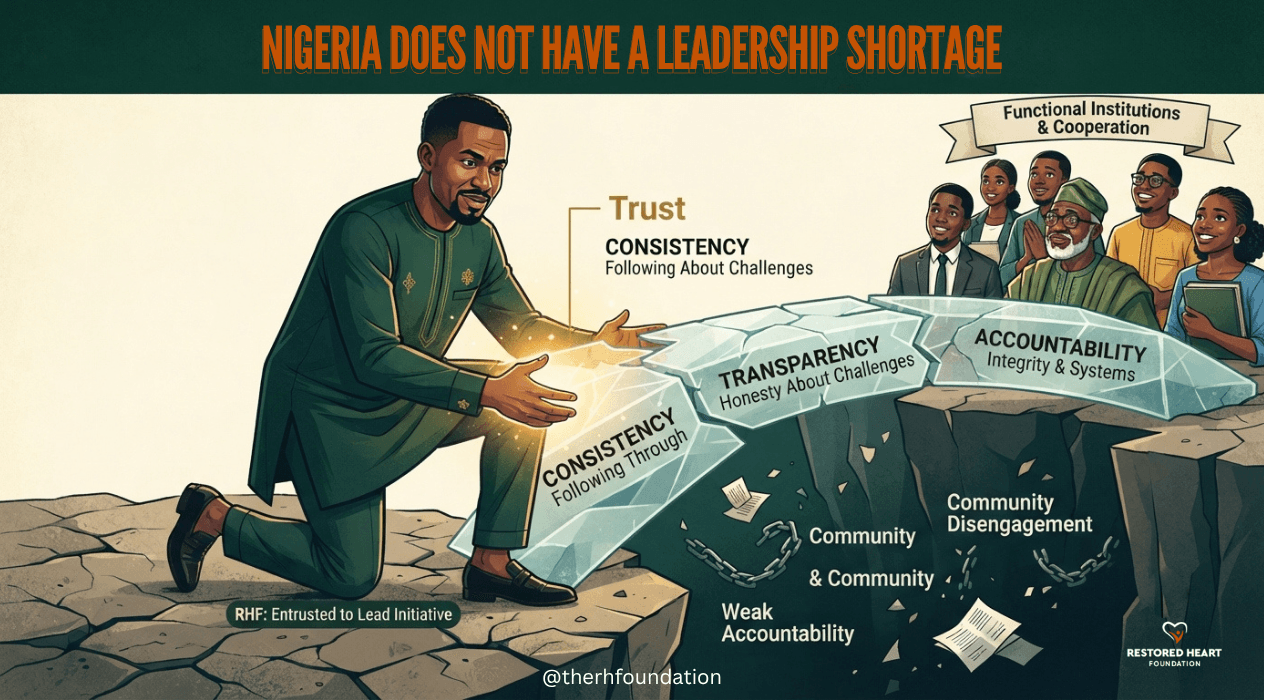
Nigeria has a lot of leaders, so let us establish that first.
We have presidents, governors, senators and local government chairmen. We have chief executives, permanent secretaries, and board members. We have pastors, imams, traditional rulers and community heads. We have, by any reasonable count, an extraordinary number of people in positions of leadership.
So, when people say Nigeria has a leadership problem, they cannot mean there are not enough people leading. The positions are filled, the titles exist, and the offices are occupied. What they mean, when they say it honestly, is that most of the people in those positions are not trusted, and trust is the only thing that makes leadership actually work.
What Trust Actually Does
Trust is not a soft concept. It is the load-bearing infrastructure of every functional institution, team, and organisation. When trust is present, things that should work actually work. When it is absent, everything requires more effort, more monitoring, more enforcement, and still produces less.
In an organisation where people do not trust leadership, decisions get made but not implemented, information gets withheld because sharing it honestly feels risky, and talent leaves because talented people consistently choose not to stay in environments where they cannot trust the people above them. Now scale that up to a country, and you get the daily experience of most Nigerians in most of their interactions with most of their institutions. The cost of that, measured in the gap between what Nigeria could be and what it currently is, is extraordinary.
Why We Keep Confusing the Problem
The trust shortage gets misdiagnosed as a leadership shortage because the solutions to a leadership shortage are relatively straightforward. You identify talented people, train them, put them in positions, and the problem improves. These are things that can be done with programs, budgets, and measurable outcomes.
The solution to a trust shortage is harder, because trust is not built through programs. It is built through character, through consistency, through being the same person in private that you claim to be in public, through making the harder right choice rather than the easier wrong one, in ordinary moments when nobody is watching.
You cannot train someone to be trustworthy the way you train someone to use Excel. The actual formation of a trustworthy leader happens deeper than any curriculum reaches, in the values shaped early, the habits built over time, and the character that was either formed or neglected before anyone gave them a title. This is why leadership development programs focused primarily on skills and competencies produce competent leaders who are not necessarily trustworthy ones, and why Nigeria keeps experiencing the same leadership failures despite significant investment in leadership training.
What a Trust Shortage Looks Like on the Ground
It looks like a community that stops showing up to meetings, not because they do not care, but because they have attended enough meetings where nothing changed to know that showing up costs more than it returns.
It looks like a health facility where medicine consistently goes missing, not because of national supply chain failures, but because the people managing the facility have learned that accountability is not real and the gap between what is reported and what happened will never be investigated.
It looks like the brilliant young person who leaves, not just Nigeria, but the room, the team, the organisation, because they have seen enough to know that their competence will be used but not recognised, their ideas taken but not credited, their loyalty assumed but never reciprocated.
These are trust failures, every single one, and they compound because each one confirms what people have already learned to expect: that leadership in this context is something that happens to you, not something done with you or for you.
What Builds Trust and What RHF Is Building
Three things build trust in leadership, and none of them is complicated, though all of them are demanding.
Consistency: doing what you said you would do when it is inconvenient, showing up when nobody would notice if you did not, making decisions that serve the people you lead rather than the ones that protect your position. There are no shortcuts here.
Transparency: People trust leaders who tell them the truth about difficult situations more than leaders who manage their perceptions of those situations. Projecting confidence while controlling information does not protect authority; it erodes trust, because people are better at detecting that gap than most leaders assume.
Accountability: not the performative kind, but the structural kind, systems that make it genuinely costly to betray the trust of the people you lead and genuinely rewarding to honour it. Individual character is necessary but not sufficient. Even trustworthy leaders operate better in systems designed to reinforce trustworthy behaviour.
This is the conversation RHF's Entrusted to Lead series was built around, and the engagement it generated confirmed something we have believed for a long time: young Nigerians working in development, governance, and civil society are hungry to have this conversation seriously and are not finding enough spaces that take it seriously.
Our conviction is that you cannot build sustainable communities without building trustworthy leaders, and you cannot build trustworthy leaders through skills training alone. Character formation is the foundation, and it requires sustained, relationship-based, values-centred engagement that most leadership programs do not provide. That is what we are building toward, and if this piece speaks to something you have been thinking about in your own work or community, we would love to continue the conversation.
Comments
Loading comments...