Inclusion Really Means What
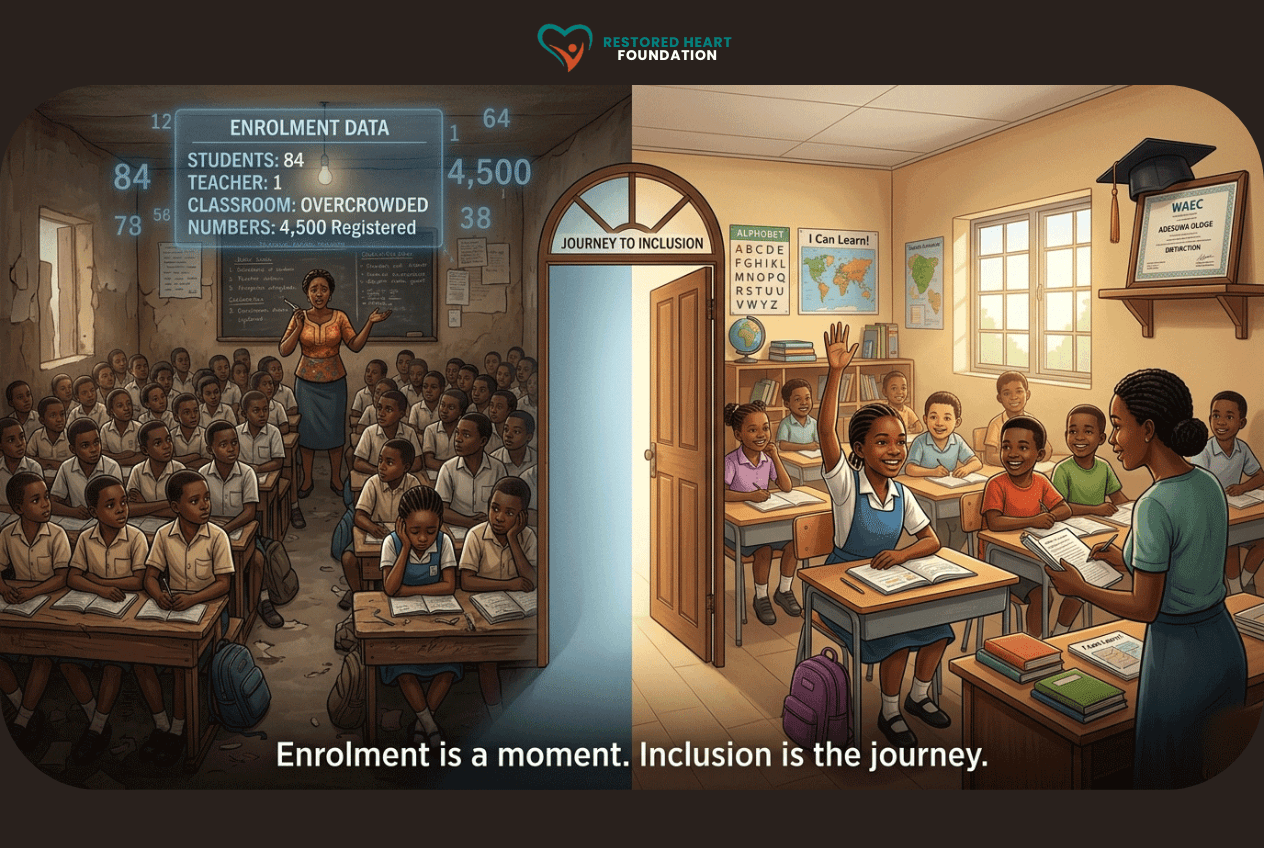
There is a number Nigeria loves to celebrate: the number of pupils enrolled in its primary schools. Politicians quote it, development reports highlight it, and it sounds like progress. In one narrow sense, it is.
But consider a student who is twelve years old, enrolled, waking up at 6 am to walk forty minutes, to sit in an overcrowded classroom with one teacher who is doing his absolute best. The statistics count her as included, but she is not so sure the statistic has ever actually met her.
That gap between what the numbers say and what her day looks like is exactly what this conversation is about.
Enrolment is a moment.
Being included means there is a qualified teacher in the room, not one person managing eighty children and calling it a lesson; it means school fees are affordable enough that families are not running quiet calculations at night about whether keeping a child enrolled is still viable; it also means a child can enter secondary school and walk out the other side with a WAEC certificate in hand.
By that definition, millions of Nigerian children who are counted as enrolled are not truly included. They are present, and they are precarious. They are inside the system until something tips them out, and something usually does.
What Tips Them Out
It is rarely dramatic. It could be that school fees are due when the money is not there, a classroom so overcrowded that the quieter children fade into the background, and nobody notices until they stop showing up, it could be that puberty is arriving with no proper information, or a family that loves its child deeply but is overburdened with responsibilities.
It is the calculation that happens at night, about who stays in school this term and who waits, who receives the investment and who defers their future for another few months.
What Changes the Calculation
A child who receives a scholarship for one term and then has to negotiate her continued presence in school every six months is not included; she is conditionally present. The calculation is still running; it just has slightly better numbers.
What actually changes the calculation is a commitment. A clear, stated, you-do-not-have-to-worry-about-this-anymore commitment that runs from where a student stands today until the morning she walks out of her final exam hall.
That kind of commitment changes how a child sees her own education, what she dares to want, how seriously her teacher takes her, and what her parents are willing to sacrifice because the sacrifice now has a guaranteed endpoint.
That is the work Restored Heart Foundation is committed to: not short-term relief, but the full-cycle investment that turns enrolment into genuine inclusion.
Join the Conversation
On June 5 at 7 pm, we are hosting an X Space titled From Policy to Practice: Making Inclusion Real for Every Child. We will be discussing exactly what it takes to close the gap between being counted and being truly supported.
Register here: https://forms.gle/GNCCEs7Q793FYF3N9
Join us live on X at @restoredheart1
If this work speaks to you and you would like to be part of the commitment we are building, reach out to us. Every child who stays in school until the end does so because someone decided the calculation was worth changing.
Comments
Loading comments...